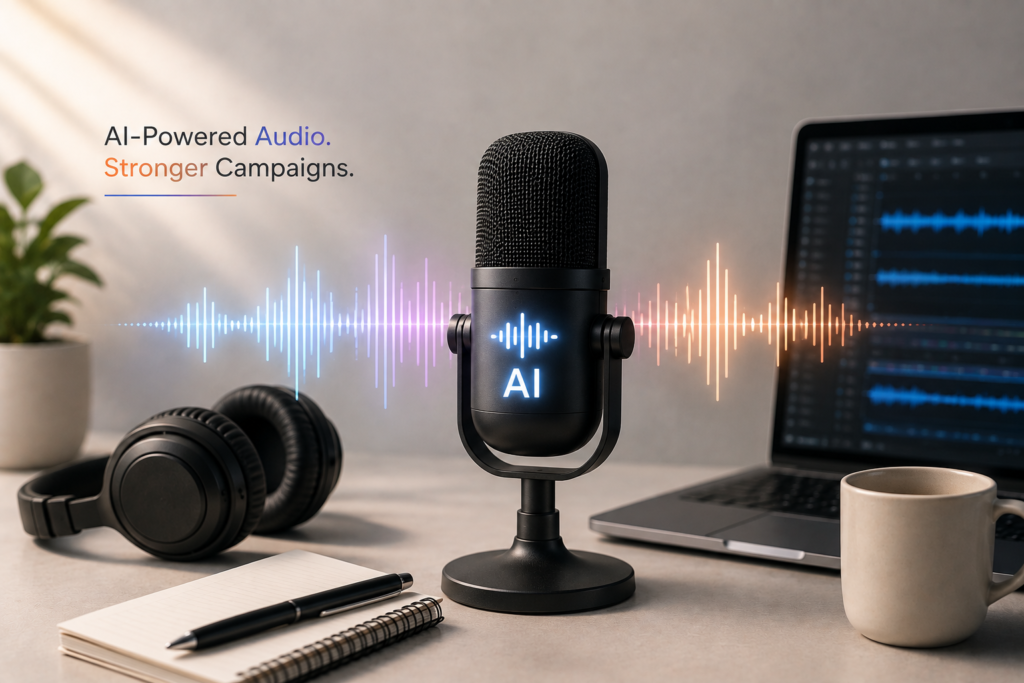
Digital marketing is constantly evolving, and artificial intelligence is becoming an important part of how businesses create and deliver content. While AI-generated images, written content, and video tools often receive most of the attention, another area is growing quickly: AI-powered audio.
From voiceovers for short videos to multilingual advertisements, podcasts, personalized messages, and audio branding, AI is changing the way businesses use sound in their marketing campaigns.
Audio has always been a powerful communication tool. A familiar voice, the right tone, or a memorable sound can make a brand easier to recognize and remember. With AI, businesses can now create and adapt audio content more efficiently while exploring new creative possibilities.
But how can businesses use AI for audio marketing effectively without losing authenticity?
Let’s explore.
What Is AI Audio in Marketing?
AI audio refers to the use of artificial intelligence to create, modify, enhance, or personalize audio content.
Depending on the tool and technology being used, AI can support tasks such as:
- Creating voiceovers
- Converting text into speech
- Improving audio quality
- Generating different voice styles
- Translating and adapting audio into multiple languages
- Creating background music or sound elements
- Editing podcasts and spoken content
- Producing personalized audio experiences
For marketers, this can help reduce the time required to produce certain types of audio content.
Instead of recording every variation of a campaign manually, businesses may be able to create multiple versions for different audiences, platforms, languages, or marketing messages.
Why Audio Matters in Modern Marketing
People consume content differently depending on the platform and situation.
Some people prefer reading a blog. Others watch short-form videos. Many users listen to podcasts, audio advertisements, voiceovers, or branded content while commuting, exercising, or multitasking.
This makes audio an important part of a complete content strategy.
Think about how often you encounter audio during a typical day:
- Instagram Reels with voiceovers
- YouTube advertisements
- Podcasts
- Brand videos
- Radio or streaming advertisements
- Voice assistants
- Educational videos
- Product explainers
The right audio can add personality and emotion to a marketing campaign.
AI gives marketers more flexibility to create this content at scale.
AI Voiceovers for Social Media Campaigns
One of the most practical uses of AI audio is voiceover creation.
Short-form video platforms require businesses to produce content consistently. Recording a professional voiceover for every Reel, advertisement, explainer video, or promotional campaign can take time and resources.
AI-generated voices can help marketers create draft voiceovers and multiple versions of a script more efficiently.
For example, a business creating a campaign can experiment with:
- Different voice styles
- Different languages
- Short and long versions
- Platform-specific messaging
- Educational or promotional tones
However, the goal should not simply be to automate everything.
A good marketing message still needs a strong script, appropriate tone, clear pronunciation, and a voice that matches the brand.
AI can support the production process, but strategy and creativity remain essential.
Creating Multilingual Marketing Campaigns
Businesses today can reach audiences across different cities, states, and countries.
Language can play an important role in building connection and trust. A customer may respond differently when information is presented in a language they understand and use every day.
AI audio tools can make it easier to adapt marketing content into multiple languages.
For example, a business may create one campaign concept and then develop different versions for:
- English-speaking audiences
- Hindi-speaking audiences
- Marathi-speaking audiences
- Regional audiences
- International customers
This does not mean every campaign should simply be translated word for word.
Effective localization requires an understanding of the audience, culture, communication style, and context. AI can help with production, while marketers should ensure that the final content feels natural and relevant.
Creating Multilingual Marketing Campaigns
Businesses today can reach audiences across different cities, states, and countries.
Language can play an important role in building connection and trust. A customer may respond differently when information is presented in a language they understand and use every day.
AI audio tools can make it easier to adapt marketing content into multiple languages.
For example, a business may create one campaign concept and then develop different versions for:
- English-speaking audiences
- Hindi-speaking audiences
- Marathi-speaking audiences
- Regional audiences
- International customers
This does not mean every campaign should simply be translated word for word.
Effective localization requires an understanding of the audience, culture, communication style, and context. AI can help with production, while marketers should ensure that the final content feels natural and relevant.
AI and Podcast Marketing
Podcasting continues to be an effective format for long-form conversations, industry insights, storytelling, and brand building.
AI can support podcast production in several ways.
It may help with:
- Audio cleanup
- Removing unwanted background noise
- Generating transcripts
- Creating summaries
- Editing long recordings
- Preparing short audio clips
- Organizing content for repurposing
This can make it easier for businesses to turn one podcast episode into multiple pieces of content.
For example, one interview could potentially become:
One podcast episode → Short video clips → Social media posts → Blog content → Email content
This approach helps businesses make better use of the content they have already created.
Personalized Audio Experiences
Personalization is becoming increasingly important in digital marketing.
Customers are exposed to a large amount of content every day. Generic messages may not always create the same impact as communication that feels relevant to a specific audience.
AI may make it easier to create different versions of audio content based on factors such as:
- Customer location
- Language preference
- Audience segment
- Product interest
- Campaign type
For example, a business could create separate audio messaging for first-time customers and existing customers.
The challenge is to use personalization responsibly and avoid making communication feel artificial or intrusive.
The best campaigns still focus on providing useful and relevant information.
Faster Content Production and Testing
Marketing campaigns often require experimentation.
A brand may want to test different headlines, scripts, voice styles, or calls to action. Traditionally, creating multiple audio versions could require additional recording sessions.
AI can make this testing process faster.
Marketers can explore different creative directions before deciding which version best supports the campaign.
This can be particularly useful for:
- Video advertisements
- Social media campaigns
- Product explainers
- Educational content
- Promotional campaigns
- Landing page videos
However, faster production does not automatically mean better marketing.
Every piece of content should still have a clear purpose. The message, target audience, platform, and desired action should guide the creative process.
The Importance of Authenticity
One of the biggest challenges with AI-generated audio is authenticity.
If a voice sounds unnatural, incorrectly pronounces words, or does not match the emotion of the message, the content may create a poor user experience.
This is why businesses should always review AI-generated audio before publishing it.
Pay attention to:
- Pronunciation
- Tone
- Emotional delivery
- Brand consistency
- Language accuracy
- Audio quality
- Overall clarity
AI-generated audio should support the brand rather than make the content feel automated.
In some situations, a real human voice may still be the better choice—especially for personal stories, emotional campaigns, interviews, or messages where authenticity is especially important.
The goal is not to replace human creativity. It is to use technology where it genuinely adds value.
How to Use AI Audio Responsibly
Businesses should also consider ethical and legal factors when using AI-generated audio.
It is important to avoid using someone’s voice or identity without appropriate permission. Brands should also be transparent where required and ensure that their use of AI respects applicable laws, platform policies, intellectual property rights, and audience trust.
Responsible use should always be part of an AI marketing strategy.
Before publishing AI-generated audio, businesses should ask:
Is this accurate?
Does it represent our brand appropriately?
Is the content clear and useful for the audience?
Are we using the technology responsibly?
These questions can help ensure that AI improves the customer experience rather than creating unnecessary risks.
The Future of AI Audio Marketing
AI is likely to continue making audio production faster, more accessible, and more adaptable.
We may see businesses creating more personalized audio experiences, multilingual campaigns, interactive content, and scalable voice-based communication.
But technology alone will not create a successful marketing campaign.
The brands that stand out will still need:
- Strong ideas
- Clear messaging
- Audience understanding
- Creative storytelling
- Consistent branding
- Human oversight
Final Thoughts
Using AI for audio in your marketing campaigns can open new opportunities for businesses to create voiceovers, improve production workflows, explore multiple languages, repurpose content, and experiment with new campaign formats.
The biggest advantage of AI is not simply that it can create audio faster.
Its real value lies in helping marketers spend more time on strategy, creativity, storytelling, and audience connection.
As AI becomes a bigger part of digital marketing, the most successful brands may not be the ones that automate everything.
They will be the ones that know where technology can help—and where the human touch still matters most.