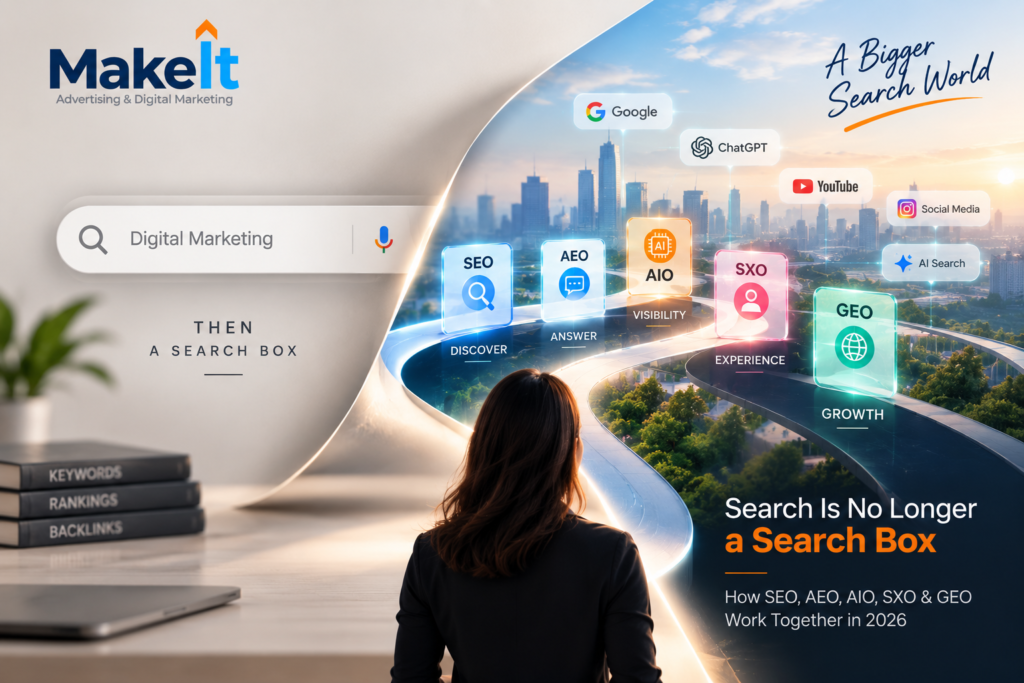
Search is changing faster than ever. People are no longer using Google only to type short keywords and browse a list of websites. Today, users can ask detailed questions, use images or voice, continue conversations with AI, and explore information through AI-powered search experiences.
Google has continued expanding AI Overviews and AI Mode, making search more conversational and capable of handling longer, more complex queries. Google also says these AI experiences continue to connect users with websites and original content.
This change is creating a new challenge for businesses: How do you make your brand visible when search is no longer just a list of blue links?
This is where SEO, AEO, AIO, SXO and GEO come into the picture.
How Search Has Changed in 2026
Traditional SEO focused heavily on ranking pages for specific keywords. While rankings are still important, the search journey is becoming much more conversational and multi-layered.
For example, instead of searching:
“Digital marketing agency Pune”
a user may now ask:
“What digital marketing strategy should a small business in Pune use to generate quality leads?”
AI-powered search can understand the context behind the question, break it into related topics and provide a more detailed response.
Google has reported that AI Mode users are asking longer and more complex questions, with AI Mode surpassing one billion monthly active users globally in 2026.
So, businesses need to think beyond simply ranking for keywords.
What Is SEO and Why Does It Still Matter?
SEO stands for Search Engine Optimization.
It is the process of improving a website so that search engines can understand its content and users can discover it through organic search.
SEO includes:
- Keyword research
- Technical SEO
- On-page optimization
- Content creation
- Internal linking
- Website structure
- Local SEO
- Authority and relevant backlinks
SEO remains the foundation because search engines still need to discover, understand and evaluate web content.
However, SEO is no longer the entire search strategy.
What Is AEO? Answer Engine Optimization Explained
AEO stands for Answer Engine Optimization.
The basic idea behind AEO is to structure content so that it clearly answers questions users are asking.
Instead of creating content only around:
a business can also answer questions such as:
- What does SEO do for a business?
- How long does SEO take?
- How does local SEO work?
- What is the difference between SEO and AEO?
This type of content helps search systems understand the relationship between questions, answers and topics.
FAQs, clear headings, concise explanations, structured content and question-based articles can all support this approach.
What Is AIO in Digital Marketing?
AIO, or AI Optimization, is a term used to describe adapting content and digital presence for AI-powered search experiences.
The terminology is still evolving, and different marketers use AIO differently. Industry discussions also show that AEO and GEO do not yet have completely standardized definitions.
For businesses, the practical focus should therefore be simple:
Create content that is clear, useful, trustworthy, context-rich and easy for both users and AI systems to understand.
This means moving away from keyword stuffing and focusing more on complete answers and genuine expertise.
What Is SXO? Search Experience Optimization
SXO stands for Search Experience Optimization.
SEO can bring someone to your website, but what happens after they arrive?
That is where SXO becomes important.
A good search experience includes:
- Fast-loading pages
- Mobile-friendly design
- Easy navigation
- Clear information
- Strong readability
- Relevant content
- Simple conversion paths
Think of the journey like this:
Search → Click → Experience → Trust → Action
If a website ranks well but loads slowly or makes information difficult to find, visibility alone may not produce meaningful results.
What Is GEO? Generative Engine Optimization
GEO stands for Generative Engine Optimization.
The concept focuses on improving a brand’s visibility within generative AI experiences.
Traditional SEO asks:
“How can I rank on search?”
GEO asks:
“How can my brand, content or expertise become useful and visible when an AI system generates an answer?”
This makes original information, clear expertise, trustworthy sources and useful content increasingly important.
Google’s current AI Search updates also emphasize helping users discover websites, original content and sources through AI-powered search experiences.
SEO vs AEO vs AIO vs SXO vs GEO
Strategy | Main Focus | Goal |
SEO | Search engines | Organic visibility |
AEO | Questions & answers | Provide useful answers |
AIO | AI-powered search | Improve AI visibility |
SXO | User experience | Improve engagement |
GEO | Generative search | Improve AI discovery |
These should not necessarily be treated as five completely separate marketing strategies.
They overlap.
How SEO, AEO, AIO, SXO & GEO Work Together
Imagine a customer searching for a service.
First, SEO helps your website become discoverable.
Then, AEO helps your content answer the customer’s questions clearly.
AIO focuses on making your information understandable within AI-powered search experiences.
Once the customer reaches your website, SXO helps create a smooth experience.
Finally, GEO focuses on visibility within generative AI environments where users may discover brands through AI-generated responses.
The complete journey can look like this:
User Search → SEO → AI/Answer Discovery → Helpful Content → Website Experience → Trust → Conversion
This is why the future of search isn’t simply about replacing SEO with AI optimization.
It is about creating a connected search strategy.
How AI Search Is Changing Lead Generation
Search visibility and lead generation are becoming increasingly connected.
A user may discover a business through a traditional Google result, an AI-generated answer, a video, a social platform or another digital source.
For seo lead generation companies, this means content strategy needs to focus not only on traffic but also on search intent and customer questions.
For example, instead of publishing dozens of articles targeting similar keywords, a business can build useful content around different stages of the customer journey:
Awareness → Research → Comparison → Decision → Conversion
This approach can help attract users who are actively looking for information and solutions.
What Businesses Should Do for AI Search in 2026
Businesses can start preparing with a few practical steps:
1. Create useful content
Answer real customer questions instead of writing content only for keywords.
2. Build topic authority
Cover important topics in depth rather than publishing disconnected articles.
3. Improve website experience
Make pages fast, mobile-friendly, readable and easy to navigate.
4. Strengthen local SEO
Keep business information, services, location details and local content accurate.
5. Add original insights
First-hand experience, examples, case studies and expert information can make content more valuable.
6. Keep content updated
Search behaviour and AI-powered search features continue to evolve, so important content should be reviewed regularly.
7. Think beyond Google rankings
Consider visibility across search engines, AI search, YouTube, social search and other discovery platforms.
Choosing a Digital Marketing Partner in the AI Search Era
Businesses looking for digital marketing support may come across searches such as “Top 10 Digital Marketing Companies in Pune” or “Top 10 Digital Marketing Companies near swargate.”
But choosing an agency should involve more than simply looking at a list.
Consider whether the agency understands:
- SEO
- Local SEO
- Content strategy
- Paid advertising
- Website optimization
- Social media
- Analytics
- AI-powered search
- Lead generation
The right strategy should be based on the business’s audience, industry, search behaviour and objectives rather than following every new marketing trend.
The Future of Search: From Ranking to Being Found
Search is moving from a simple keyword → ranking model toward a broader discovery ecosystem.
Users can now search through conversations, questions, images, voice and AI-powered experiences. Google’s latest Search developments show continued movement toward conversational AI, multimodal inputs and deeper connections between AI responses and web content.
That means businesses need to think about more than:
“Where does my website rank?”
They also need to consider:
“Can people find my brand?”
“Can search systems understand my expertise?”
“Does my content answer real questions?”
“Is my website experience good?”
“Can my brand be discovered through AI-powered search?”
Final Takeaway
SEO is not disappearing in 2026. Instead, the search ecosystem is expanding.
SEO helps you get discovered.
AEO helps you answer.
AIO helps you adapt to AI-powered search.
SXO improves the user’s experience.
GEO focuses on generative search visibility.
The future of digital marketing is not about choosing one acronym over another. It is about building content, websites and digital experiences that are useful to people and understandable across modern search experiences.
Search is no longer just a search box. It is becoming an entire discovery journey.