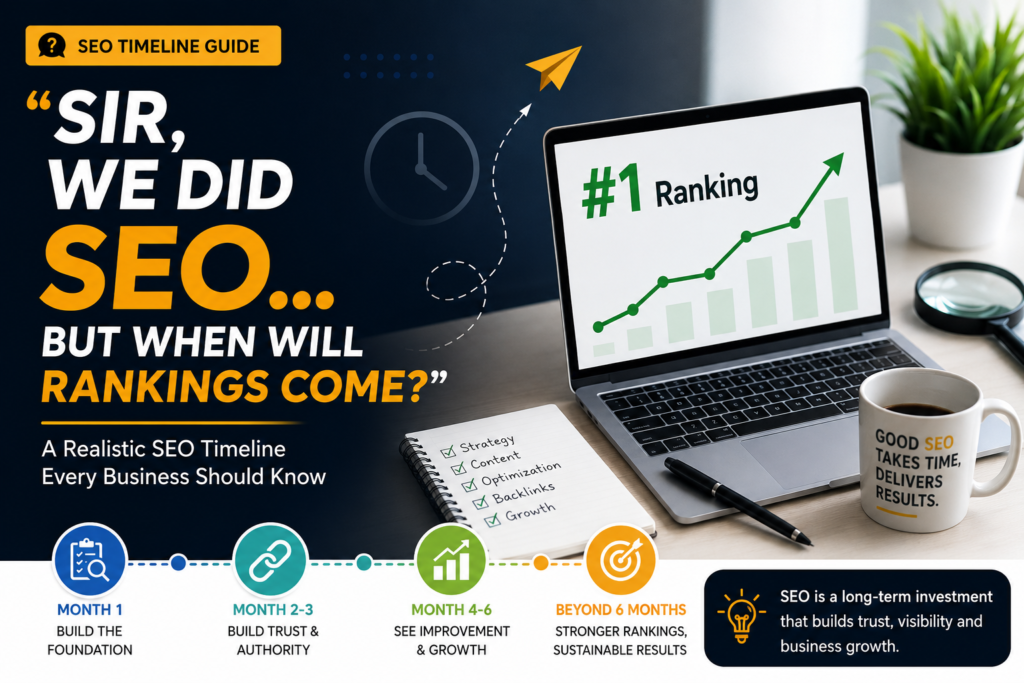
When a business starts investing in Search Engine Optimization, one question almost always comes up after a few weeks:
“Sir, We did SEO… but when will our rankings improve?”
It’s one of the most common and understandable questions asked by business owners. After all, every investment is expected to generate results. However, SEO works differently from paid advertising.
If you run Google Ads today, your website can start receiving visitors within hours. SEO, on the other hand, is a long-term strategy that focuses on earning Google’s trust rather than buying visibility.
This is why patience, consistency, and continuous improvement are essential.
Whether you own a local business or an established company, understanding how Google ranks websites will help you build realistic expectations and avoid disappointment.
Businesses working with an SEO Company in swargate often expect immediate first-page rankings. In reality, Google follows a much more detailed evaluation process before deciding where a website should appear.
Why Doesn't SEO Show Results Immediately?
Imagine opening a brand-new restaurant in a busy city.
Even if the food is excellent, customers don’t automatically know about it.
People need time to:
- Discover your business
- Read reviews
- Trust your brand
- Recommend it to others
Google behaves in a very similar way.
Every website must earn trust before receiving strong rankings.
Search engines evaluate hundreds of ranking signals before placing your pages above competitors.
Some of these include:
- Website quality
- Helpful content
- Technical performance
- Mobile experience
- Page speed
- User engagement
- Authority
- Backlinks
- Search intent
Because Google continuously analyzes these signals, rankings improve gradually—not overnight.
Understanding Google's SEO Process
Many businesses assume SEO simply means adding keywords to a webpage.
Modern SEO is much more advanced.
Google generally follows these stages before improving rankings.
1. Crawling
Google discovers your website and reads its pages.
If important pages cannot be crawled correctly, they cannot rank.
2. Indexing
After crawling, Google stores your content inside its database.
Only indexed pages become eligible to appear in search results.
3. Understanding Content
Google tries to understand:
- What your page is about
- Which questions it answers
- Whether the information is accurate
- How helpful it is for users
This is where content quality becomes extremely important.
4. Comparing Competitors
Google doesn’t rank your website alone.
It compares your page against hundreds of competing websites targeting the same keywords.
If another website provides:
- Better information
- Faster loading speed
- Higher authority
- Stronger backlinks
Google may rank that page first.
5. Measuring User Experience
Google also watches how users interact with your website.
For example:
- Do visitors stay on your page?
- Do they immediately leave?
- Is your website easy to navigate?
- Does it work well on mobile devices?
Positive user experiences help strengthen rankings over time.
What Happens During the First Month of SEO?
Many business owners become worried because they don’t notice immediate changes.
The truth is that the first month is usually dedicated to building a strong foundation.
Professional SEO generally begins with:
Website Audit
Finding technical problems such as:
- Broken links
- Duplicate pages
- Missing metadata
- Slow loading speed
- Mobile usability issues
Keyword Research
Instead of guessing keywords, SEO professionals identify search terms that customers are actually using.
This helps attract relevant traffic rather than random visitors.
On-Page SEO
Every important page is optimized by improving:
- SEO Titles
- Meta Descriptions
- Header Structure
- URL Structure
- Image Optimization
- Internal Linking
Technical SEO
Technical improvements include:
- XML Sitemap
- Robots.txt
- HTTPS
- Schema Markup
- Core Web Vitals
- Mobile Optimization
Although these improvements are not immediately visible, they create the technical foundation that Google expects from quality websites.
Month Two to Three: Building Google's Trust
This is where patience becomes important.
Google has already discovered your website.
Now it begins measuring consistency.
During this period, SEO activities usually include:
- Publishing helpful blog articles
- Optimizing service pages
- Building quality backlinks
- Strengthening internal linking
- Updating Google Business Profile
- Improving local SEO signals
Keyword rankings often fluctuate during this stage.
Some keywords move higher.
Some move lower.
This is completely normal.
Google continuously tests how users respond to your content before deciding where it deserves to rank.
Businesses often become impatient during this stage, but this is actually when Google is gathering valuable trust signals.
Month Four to Six: When Results Usually Begin
If SEO has been implemented consistently, this period usually brings noticeable improvements.
Businesses may begin seeing:
- Higher Google impressions
- Better keyword rankings
- Increased organic traffic
- More qualified visitors
- Improved local visibility
- Higher click-through rates
- Better website engagement
However, the timeline depends heavily on competition.
For example, ranking for a local niche keyword may happen much faster than ranking for highly competitive marketing-related searches.
What Actually Determines Your SEO Ranking Speed?
No agency—including Google itself—can promise a fixed ranking timeline.
Several important factors influence how quickly a website grows.
Website Age
Older domains generally have stronger authority because they have existed longer.
Competition
Highly competitive industries naturally require more time.
Content Quality
Google rewards websites that publish useful, original, and experience-based content.
Technical SEO
Fast-loading websites with excellent user experiences usually perform better.
Backlinks
Quality backlinks continue to be one of Google’s strongest trust signals.
One link from a trusted website is often more valuable than dozens of low-quality links.
Why Do Some Businesses Rank Faster Than Others?
One of the biggest misconceptions about SEO is that every website follows the same timeline. In reality, two businesses targeting the same keywords can experience very different results.
Imagine two companies that both start SEO on the same day.
Business A
- Website is 6 years old
- Regularly publishes blogs
- Has positive Google reviews
- Loads quickly on mobile devices
- Has quality backlinks
Business B
- Brand-new website
- Very little content
- No backlinks
- Slow loading speed
- No local SEO optimization
Even if both invest the same amount in SEO, Business A is likely to achieve faster results because Google already trusts its website.
This is why SEO is not just about adding keywords—it is about building authority over time.
Common SEO Mistakes That Delay Rankings
Many businesses unknowingly slow down their own SEO progress.
Some of the most common mistakes include:
Expecting Instant Results
SEO is a long-term investment. Businesses that expect first-page rankings within a few weeks often become discouraged and stop their efforts too early.
Publishing Thin Content
Writing short pages with little useful information provides very little value to users or search engines.
Google rewards content that answers questions thoroughly and demonstrates expertise.
Ignoring Technical SEO
Even excellent content can struggle if the website has technical issues such as:
- Broken pages
- Slow loading speed
- Poor mobile experience
- Missing metadata
- Crawl errors
Technical SEO creates the foundation for good rankings.
Keyword Stuffing
Adding the same keyword repeatedly does not improve rankings.
Modern SEO focuses on natural language and user intent rather than repetition.
Stopping SEO Too Early
One of the biggest mistakes businesses make is stopping SEO after one or two months because they don’t immediately see dramatic improvements.
SEO rewards consistency.
Why Blogging Accelerates SEO Growth
Every high-quality blog creates another opportunity for your website to appear in Google Search.
Instead of relying only on service pages, blogs help businesses answer customer questions before they make purchasing decisions.
A good blog can:
- Target long-tail keywords
- Improve topical authority
- Increase organic traffic
- Build trust
- Support internal linking
- Generate AI search visibility
Over time, a collection of helpful articles signals expertise to Google.
This is one reason businesses investing in the best digital marketing services in swargate often prioritize consistent content creation alongside technical SEO.
How AI Is Changing SEO in 2026
Artificial Intelligence is changing how people search for information.
Today, users increasingly ask questions directly to AI platforms instead of relying only on traditional search engines.
However, AI has not replaced SEO.
Instead, it has made quality content even more important.
AI systems prefer information that is:
- Accurate
- Well-structured
- Experience-based
- Frequently updated
- Easy to understand
Businesses that publish original, trustworthy content are more likely to be referenced by AI-powered search experiences.
This means investing in quality content today supports both traditional SEO and future AI search visibility.
What Should Businesses Measure Instead of Rankings?
Rankings are important, but they are not the only indicator of SEO success.
Instead of checking rankings every day, businesses should monitor:
- Organic Traffic
- Google Impressions
- Click-Through Rate (CTR)
- Website Engagement
- Qualified Leads
- Contact Form Enquiries
- Google Business Profile Performance
- Brand Searches
These metrics provide a more accurate picture of long-term growth.
Why Local SEO Matters More Than Ever
For businesses serving a specific city or area, Local SEO plays a crucial role.
Google considers:
- Business location
- Google Business Profile
- Customer reviews
- Local citations
- Consistent business information
Businesses searching for the best seo in pune often focus on improving local visibility because customers increasingly search for services “near me” or within specific locations.
Strong Local SEO helps businesses appear in Google Maps, local search results, and AI-powered recommendations.
SEO Is About Building Trust
Think of SEO as building a professional reputation.
You don’t become trusted overnight.
Google observes whether your business consistently provides helpful information, maintains a high-quality website, and delivers a positive user experience.
Every blog you publish…
Every page you improve…
Every technical issue you fix…
Every satisfied customer review…
These small improvements combine to strengthen your website’s authority over time.
That is why SEO is often described as a marathon rather than a sprint.
Frequently Asked Questions
How long does SEO usually take?
Most websites begin seeing noticeable improvements within 3–6 months, while competitive industries may require 6–12 months for stronger rankings.
Can anyone guarantee first-page rankings?
No. Search engines control rankings, and no agency can honestly guarantee a specific position.
Does blogging improve SEO?
Yes. Helpful blogs expand your website’s authority, target additional keywords, and answer customer questions, improving long-term visibility.
Is Local SEO important?
Absolutely. Local SEO helps businesses appear in location-based searches, Google Maps, and Google Business Profile results.
Can AI replace SEO?
No. AI is a powerful tool for research and productivity, but successful SEO still depends on strategy, expertise, technical optimization, and valuable content.
Final Thoughts
SEO is one of the most valuable long-term investments a business can make—but it requires patience, consistency, and a commitment to quality.
Instead of expecting immediate rankings, businesses should focus on creating helpful content, improving technical performance, and building trust over time.
Google rewards websites that consistently provide value to users.
Whether you’re working with an SEO Company in swargate or investing in the best digital marketing services in swargate, the goal should never be quick wins—it should be sustainable growth.
As search engines continue to evolve, businesses that prioritize user experience, expertise, and continuous improvement will remain competitive. By following ethical SEO practices and publishing valuable content regularly, companies can strengthen their online presence, attract qualified visitors, and achieve long-term success.
Remember, SEO doesn’t reward the fastest website to start—it rewards the website that consistently delivers the best experience to its audience.